 English
 Español

Latest News
Latest News
Latest News
Latest News
Latest News
Latest News
Latest News
Latest News
Latest News
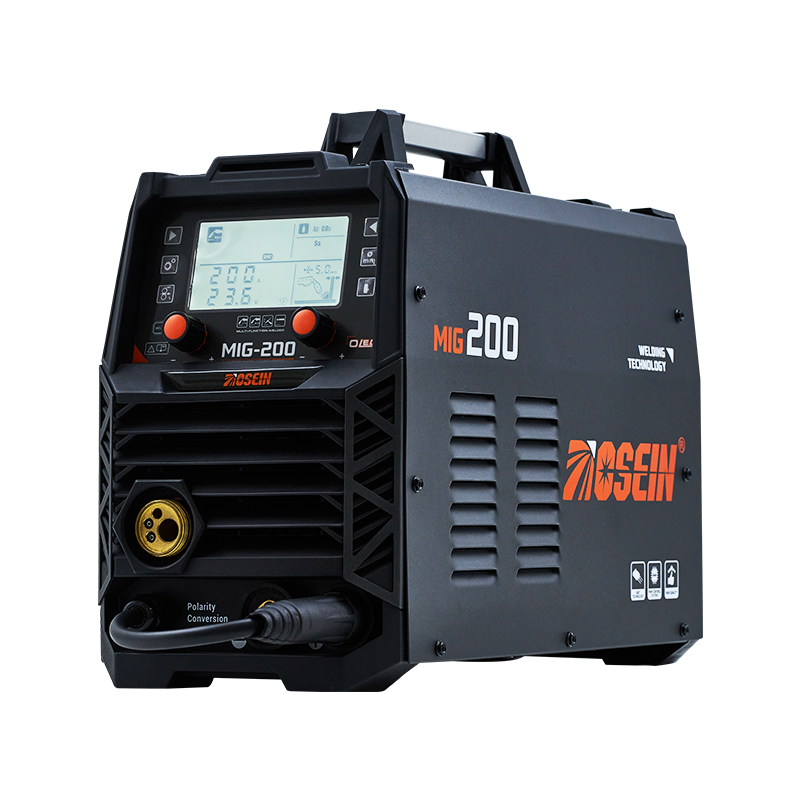
A MIG 200 Gas Shielded Arc Welding Machine is often expected to deliver smooth short-circuit transfer even on thin materials, yet arc fluctuation at low amperage remains a frequent complaint among users. At reduced current ranges, the welding process becomes more sensitive to minor electrical, mechanical, and shielding inconsistencies. Even small deviations in wire feed or contact quality can break arc continuity, resulting in spatter, uneven bead shape, or intermittent stuttering. Low-current operation (typically around 30–90A depending on wire diameter and polarity setup) reduces the thermal buffer of the weld pool. That narrower energy window exposes weak points in grounding, consumables, and gas shielding performance. Understanding these variables helps explain why arc stability changes dramatically at the lower end of a MIG 200’s operating range.
Wire Feed Sensitivity at Reduced Amperage
At low current settings, wire feed consistency becomes more critical than at higher power output. The melting rate is slower, so any variation in wire speed immediately affects arc balance.
- Drive roll tension mismatch can cause intermittent slipping or excessive compression of welding wire, especially with 0.6 mm or 0.8 mm wire used on light sheet metal.
- Liner friction buildup increases resistance, causing jerky wire delivery that destabilizes short-circuit transfer cycles.
- Contact tip wear (0.8 mm tip used with 0.8 mm wire) enlarges internal clearance, reducing electrical transfer consistency at lower amperage.
A MIG 200 system running low voltage settings (typically 14–18V for mild steel sheet welding) depends heavily on uniform wire push force. Any disruption quickly appears as arc flutter or micro-breaks in conduction.
Electrical Resistance Effects in Low Current Mode
Reduced amperage magnifies the influence of resistance in the welding circuit. A stable arc requires uninterrupted conductivity from machine to workpiece, but small losses become more noticeable under low energy conditions.
- Ground clamp oxidation increases circuit resistance, weakening return current flow and causing arc hesitation.
- Loose DINSE connector fittings create micro-arcing inside the connection path, often mistaken for unstable arc behavior.
- Voltage drop across long welding cables becomes more significant at low settings, especially with 2.5 m–3.0 m cable extensions.
A MIG 200 machine operating near minimum output relies on clean electrical pathways. Even minor contamination on grounding points can disrupt the short-circuit transition rhythm, making the arc feel “nervous” or inconsistent.
Shielding Gas Flow Imbalance
Gas shielding performance plays a larger role in arc behavior at low current because the molten pool is smaller and more exposed to atmospheric interference.
- Flow rate below 10–12 L/min may allow air intrusion, increasing oxidation and arc instability.
- Excessive flow above 18–20 L/min creates turbulence that disturbs the arc column.
- CO₂-rich shielding mixtures (such as 80/20 or 75/25) produce more reactive arc behavior compared with argon-rich blends at low amperage.
A MIG 200 system operating with mixed gas is especially sensitive during thin plate welding (0.8–2.0 mm steel). Small disruptions in gas envelope stability often appear as arc wandering or uneven bead wetting.
Stick-Out Length and Arc Stability Control
Wire stick-out, also called electrode extension, directly influences current density at low amperage settings. Longer extension reduces heat concentration at the arc point, which can destabilize the transfer cycle.
- Excessive stick-out beyond 12–15 mm weakens arc focus and increases spatter formation.
- Too short extension under 6 mm overheats the contact tip and interrupts smooth feeding.
- Inconsistent torch distance during hand movement causes repeated micro-changes in arc length.
At low current output, MIG 200 machines depend on stable arc length control to maintain short-circuit timing. Minor variations translate directly into audible popping or visible arc flicker.
Voltage-Wire Speed Mismatch at Low Settings
Voltage and wire feed speed must remain synchronized. Low-amperage welding reduces tolerance for imbalance between these two parameters.
- High wire feed speed with low voltage forces wire into the weld pool too aggressively, causing stubbing.
- Low wire feed speed with excessive voltage stretches the arc length and weakens transfer stability.
- Incorrect chart settings for 0.8 mm steel wire often appear more obvious at reduced power ranges.
A MIG 200 Gas Shielded Arc Welding Machine typically uses synergic or semi-synergic curves, but manual tuning is still required for thin sheet applications. Small deviations produce exaggerated instability compared with medium or high current welding.
Material Condition Influence at Low Heat Input
Base material preparation becomes more critical as heat input decreases. The arc has less energy to burn through contaminants.
- Mill scale and rust layers interrupt electrical conductivity at the weld interface.
- Oil or coating residues vaporize unevenly, disturbing arc plasma stability.
- Paint remnants near weld zones cause intermittent gas contamination pockets.
Low-current MIG welding depends on clean metal surfaces because arc penetration is shallow. Any barrier forces the arc to constantly re-adjust, which appears as instability.
Low-Current Stability Depends on System Balance
Arc instability in a MIG 200 Gas Shielded Arc Welding Machine at reduced amperage rarely originates from a single fault. The behavior usually reflects the combined effect of wire delivery precision, electrical integrity, shielding gas control, and surface condition of the workpiece. Each subsystem carries more influence as current decreases, reducing the margin for error. Stable operation at low settings requires tight coordination between voltage (typically 15–18V for thin steel), wire feed speed calibration, clean grounding paths, and consistent torch handling. Once these variables align, arc behavior becomes noticeably smoother even at minimal output levels.